
LeBlancville
The historical village of LeBlancville dates back to the early 1850s when settlers first arrived. Starting at the Kent-Westmorland County line on the Westmorland side, LeBlancville extends to the most southwestern part of Notre-Dame where Irishtown begins. It is therefore the entry point to Notre-Dame when travelling north on Route 115 from Moncton.
There is an important crossroad on this stretch of highway, the corner of Cove Road and Poirier Office Road. The area was also home to settlers in Village des Fricots.
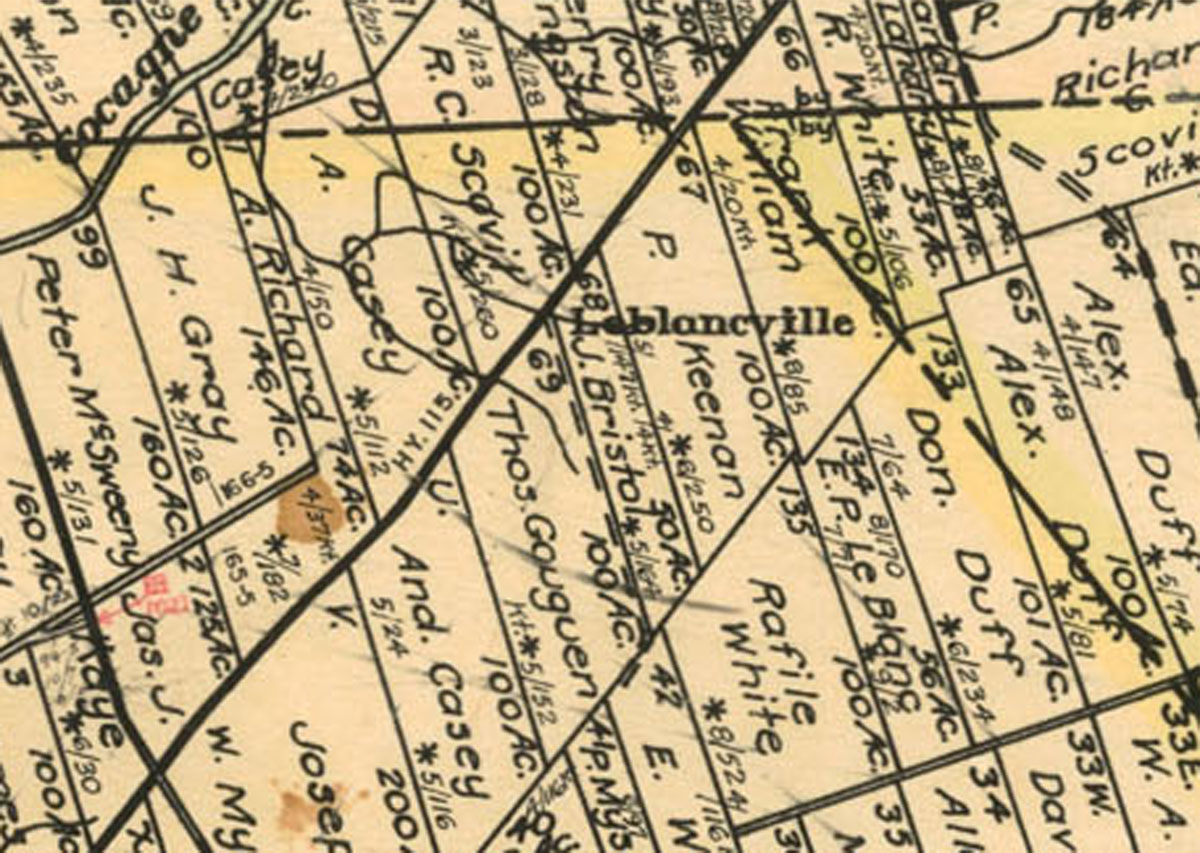
LeBlancville-old-map-crop
1800 to 1850
1850
On March 20, Pierre and François Bourg (Beaumont-Memramcook) jointly purchased 100 acres of land from James Black, and became the first Acadian settlers just southwest of the heart of the village. They were soon joined by Mélème Bourg, Béloné LeBlanc, and Laurent (dit Hunker) LeBlanc (Fox Creek), Pierrot LeBlanc (Memramcook), Amant, Thomas and Beloni Surette (Petitcodiac).
James A. Black owned several large parcels of land in the area (name to soon change to Scovil’s Mills), but he did not live in the area. He was born in Dorchester, NB in 1790, and he died on April 10, 1863. He is buried in the Dorchester Pioneer Cemetery.
He was married to Elizabeth Etter Black who was born in 1789 and who died on June 29, 1874. She is also buried in the Dorchester Pioneer Cemetery. They had six or seven children.
James’ father was William Black Sr. and he was born on October 11, 1727, into a wealthy family living in Paisley, Renfrewshire, Scotland. He became a travelling salesman in linens and draperies. During a business trip to Huddersfield, Yorkshire, England, he met Elizabeth Stocks. William and Elizabeth were married there around 1758.
William was drawn to “the new world” and its many opportunities. In the spring of 1775, he chartered the “Jenny” in Hull, England and sailed to Nova Scotia with his family, wife, Elizabeth, and five children. Elizabeth suffered injuries on the boat, which may have contributed to her untimely death the following year in Amherst, Cumberland County, NS.
The Immigrant Ships Transcribers Guild record the Jenny departing Hull, Yorkshire on April 10, 1775, with first stop being Fort Cumberland, Nova Scotia and where the Black family disembarked. William Black was forty-three, his wife, Elizabeth, was thirty-six, and the five children varied between seven and fifteen.
Elizabeth Stocks Black was from Huddersfield, Metropolitan Borough of Kirklees, West Yorkshire, England (born in 1739). She was brought up in higher circles, and took with her fancy clothing such as her scarlet riding habit and cap as well as embroidered satin dresses to “the new world”. She found little use for these fine clothes.
William did not remain a widower. He married Elizabeth Abber, who was born in 1750 in Ireland, and they had 5 children. She died in Dorchester, NB in 1813 and is buried in the Dorchester Pioneer Cemetery. Following her death, William purchased a large estate in Dorchester, where he lived with his son, Joseph. He died there on April 11, 1821.
1851 to 1875
1853
André Caissie settled as one of the first inhabitants of LeBlancville. He was granted land, on April 19, 1853.
1864
Peter Keenan was granted land on September 17, 1864, and settled in LeBlancville. Soon afterwards arrived Amable LeBlanc (mason from Memramcook), Simon Caissie, Hypolite Melanson (Cocagne), Beloni Richard, and André Cormier.
A historical map showed land also owned by Thomas Goguen and A. Richard as well as Peter McSweeney, R.C. Scovil, and P. Keenan among others.
1876 to 1900
Around 1880
Two schools were built: a French school in LeBlancville which remained open until 1946 and an English school in MacDougall Settlement, which remained open until 1958.
1889
A territory was established for the new church, the parish was canonized, and the community welcomed its first resident priest, Père Honoré Ouellet, who stayed until 1897. Between 1889 and 1923, the Parish of Notre-Dame served the neighbouring community of Saint-Antoine.
1894
On May 30, 1894, Philip Goguen exchanged $4.25 worth of potatoes and bought two sheep from Maximin Babineau for $2.50 as noted in a record of household affairs.
1895
On June 10, 1895, Maximin Babineau bought one pair of oxen for $40 as noted in a record of household affairs.
1896
On May 21, 1896, the MacDougall family home was destroyed by fire. A new home was built at the same location.
1896
In June 1896, Edward White hired several men to work: Fred Barnes, Thomas Scott, John Cochran, Silvain Goguen, Maxime Goguen, and Philip A. Goguen.
1901 to 1925
1900
One-half ton of hay cost $3.50, one bushel grass seed $2.50, one pair of shoes $1.10, five locks and nobs $1.50, one bottle of Mother Seigel $0.30, one hundred lbs of flour $5, three lbs of tea $1.20, one gallon of oil $0.25, and one bottle of liniment $0.35 according to a record of household affairs.
1901
The Catholic Church was officially named Notre-Dame-du-Sacré-Coeur and the Parish subsequently defined the territory of the community of Notre-Dame. The hamlets (or historical villages) included were: MacDougall Settlement, Poirier Office, LeBlancville, Dufourville, Notre-Dame Centre, Guéguen, Hays, Alexandrina-Nor’ouest, North and South sides of the river, Whites Settlement, along with Village des Pishcots, Village des Fricots, Suretteville, Teed Road, and Chemin des Thaddées.
1902
A post office was operating in LeBlancville. It served the community until 1918 and again between 1927 and 1954. Albert Caissie was the postmaster for many years.
1904
LeBlancville was described as being a farming settlement with one post office and a population of 50.
Note: In the 1900s, teachers were hired by local parent committees. The teachers were “housed and fed” around the school. Inspectors, hired by Dundas Parish administrators, visited the school regularly and wrote detailed reports that would influence and bring about change.
1925 to 1950
1932
A few people had electricity as early as 1932 and, by 1940, service was widespread but did not reach every corner of the village. This proved to be a fatal blow to several hamlets and the main reason why these areas were eventually abandoned, such as Alexandrina-Nor’ouest, chemin des Thaddées, Village des Pishcots, Village des Fricots, and Suretteville.
1945
A new school was built in LeBlancville and it remained open until 1966.
1950-1951
Under Father Emery Doucet’s watchful eye, contractor Abbey Landry (Memramcook) built a new large and modern Catholic church in Notre-Dame, as per plans drawn by architects Lévesque et Venne of Québec. Arthur Landry managed the work performed by local tradesmen. The exterior red bricks came from Chipman. The “table de communion” was sculpted by the Bourgeaults of St-Jean-Port-Joli, QC while the iron work was done by Aurèle Marois. The Bourgeaults also made the church pews. The church bell was forged at Fonderie Paccard (France) and weighs 658 lbs. L’Église Notre-Dame-du-Sacré-Coeur remains a beautiful landmark.
1951 to 1975
1954-1956
A home postal delivery service was introduced in Notre-Dame. Mail was delivered by drivers who would insert letters and parcels in mailboxes next to the road of each house and business throughout the community. One route started at the Notre-Dame Post Office then onward to Hays, Alexandrina-Nor’ouest, across the covered bridges to Poirier Office, LeBlancville, Dufourville, and ending, where the route began, at the post office. Delivery areas grew to include Guéguen and the South side of the river road. The MacDougall Settlement mail delivery was and remains part of a different route.
With the arrival of mailboxes and home postal delivery, several small post offices were closed, such as Dufourville, LeBlancville, Alexandrina-Nor’ouest, Poirier Office, and MacDougall Settlement.
Postal delivery was first done, and for many years, by Joe Delaney followed by Thomas Robichaud, M. Delaney, Olivier Bourque, Alcide Pellerin, Frank Maillet, Regis Bourque, and others.
1958
Notre-Dame was made up of 7 different school districts: Upper Guéguen, Hays, Alexandrina, LeBlancville, Dufourville, MacDougall Settlement, and Notre-Dame. A few years back, the Whites Settlement District had joined Cocagne. The school board was responsible for school maintenance and repair as well as for the hiring of teachers, heating, and other expenses, paid for by local taxes.
1959
On January 14, 1959, the two-room wooden schoolhouse École de Dundas was destroyed by fire. Classes are held in the parish hall and in the church basement. Ten short months later, a new two storey brick school was officially opened on November 14. L’école Centrale de Notre-Dame continues to cater to francophone students from the four corners of the community. Today, it is known as École Notre-Dame. First principal was Roméo Robichaud, followed by Gérald Aucoin, who remained for many years. President of the School Board was Ernest Gallant.
1966
The school at LeBlancville closed. Shortly afterwards, the school at Dufourville also closed.
1976 to 1990
1979
The board of directors of the “Club athlétique de Notre-Dame” undertook the building of a large community center with leisure and sport facilities. From the beginning, the centre was very busy. Equipped with a kitchen and bar, the large hall was ideal for dancing, meals, events, weddings, anniversaries, private parties, and other activities and events. Many fundraisers were held there. The split-level basement housed bowling alleys and multi-purpose rooms for non-profits organisations such as the Knights of Columbus, Golden Age Club, ATV, literacy classes, etc. People came from afar for the music, bingo, cards, amateur nights, carnivals, cultural activities, book launchings, etc.
On the community ballfields were held two national women’s softball championships in 1988 and in 1991. The local team did very well at both national events, especially in 1991 when the host team, the Athletes, won the Canadian Championship. The Community Centre underwent major renovations in the early 2000s when the bowling alleys were dismantled and the space converted into an exciting youth centre known as Place jeunesse centrale.
In 2011, weight of snow collapsed the roof during the night of Wednesday, January 26. Luckily no one was in the building at the time, as the evening before, the hall had been full of people playing the card game of “200”. The damage, however, was extensive. A group of volunteers teamed up to coordinate the necessary work leading to the ravaged building being demolished and to build the new community centre. In 2012, exactly one year later to the day, the new bigger one storey building opened its doors to the public. The Notre-Dame Community Centre remains very active.
In 2012, exactly one year later to the day, the new bigger one storey building opened its doors to the public. The Notre-Dame Community Centre remains very active.
2000
In March, the postal addresses were changed from site and box number, to civic numbers thereby improving efficiently and visibility especially for emergency services such as fire and balance services.